

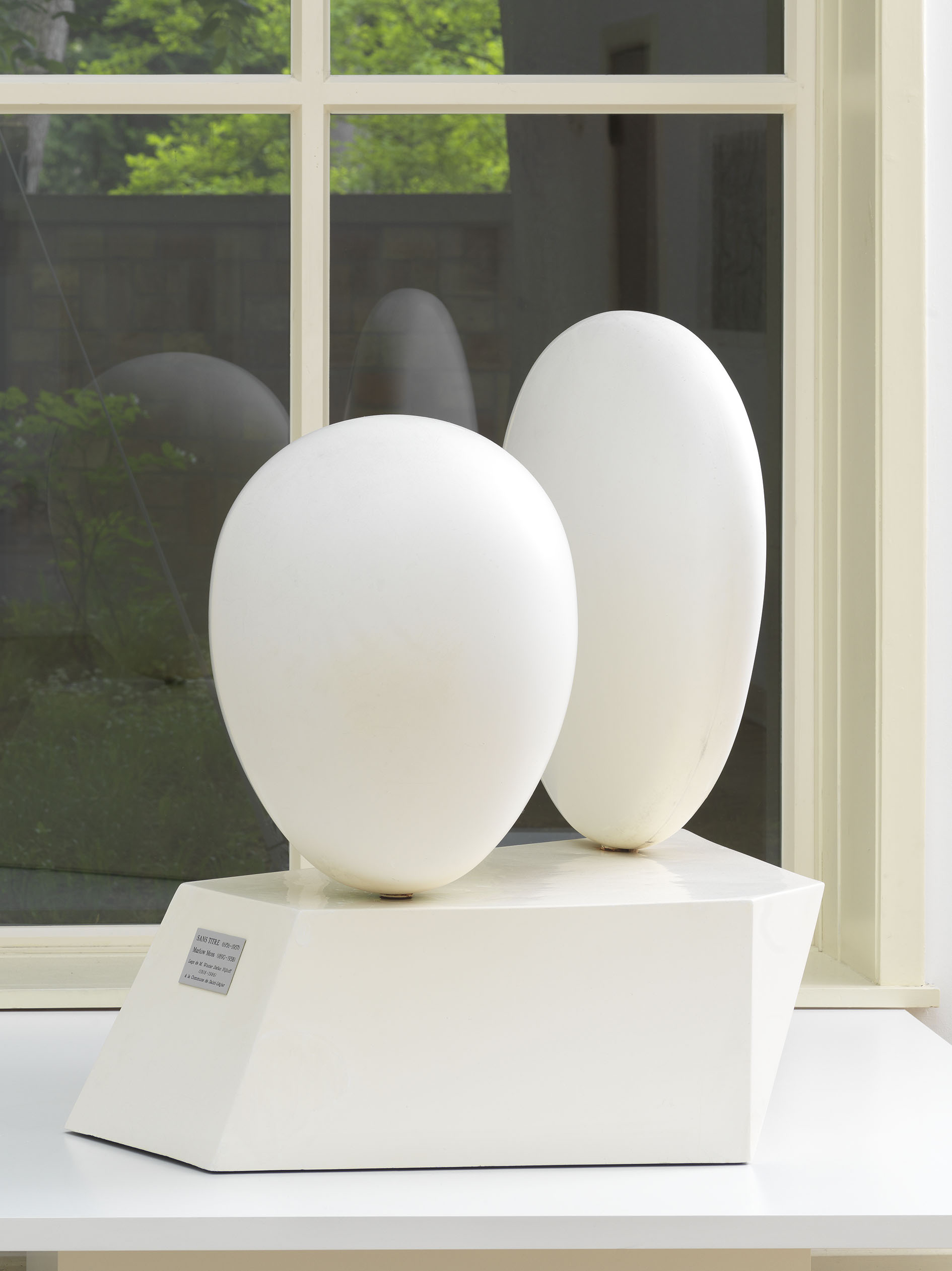
Marlow Moss (1889-1958)
Sans Titre (1956-1957)
Painted glass fiber reinforced polyester resin
Municipality of Blonay–Saint-Légier, Switserland
Legacy of M. Wouter Stefan Nijhoff (1916-1986)
In 2026, the Georg Kolbe Museum presents a significant exhibition of sculptures by the constructivist Marlow Moss (1889–1958). It is the first major showing of this groundbreaking artist in Germany— bringing a key figure of abstract art into the spotlight.
As one of the few women active and recognized in avant-garde circles, and as a member of the Paris-based artists’ association Abstraction-Création, Moss developed a distinctive formal language bridging painting and sculpture. Through her rigorously rhythmic compositions, geometric reliefs, and innovative use of the double line in Constructivist painting and sculpture, she sought a universal order of colour, line and space.
For a long time, her practice remained in the shadows of art history — not least because of persecution, exile, the loss of many works, and her queer identity. The Georg Kolbe Museum presents it in an exhibition, bringing together for the first time the remaining sculptures by Marlow Moss. The show is complemented by paintings, drawings, photographs, films, and archival material that together convey an impressive picture of Moss’ artistic vision and eventful life.
The outstanding contemporary artists Leonor Antunes (b. 1972), Tacita Dean (b. 1965), Florette Dijkstra (b. 1963) and Ro Robertson (b. 1984) contribute their own artistic perspectives to the exhibition, opening up different connections to Moss. The vibrant dialogue between the artworks creates a compelling encounter between past and present.
The exhibition brings together loans from major museums and archives in the United Kingdom, the Netherlands, Switzerland, France, the USA and Germany, as well as from numerous private collections.
The project is curated by Dr Lucy Howarth and Dr Elisa Tamaschke.
A bilingual catalogue (German/English) is published by Hirmer Verlag.
Text: Georg Kolbe Museum
Photo: Jens Ziehe
See also: article in The Guardian
One of the works on display is owned by the Municipality of Blonay–Saint-Légier in Switzerland and was exhibited outdoors there for at least forty years. The large, white-painted polyester sculpture consists of a base form with seven faces, derived from a cube, topped by two spheres placed one behind the other. The sculpture may have been modelled on a now-lost original made of stone or marble. Early black-and-white photographs have been found showing the spheres – one smaller and round, the other elongated and larger – arranged in reverse order on the base. For the exhibition, the cleaning, filling and retouching of damage to the paint layer and to the glass-fibre-reinforced polyester casting resin were given the highest priority. The sculpture required restoration due to its vulnerability to the elements, including weather, sunlight, dirt, and organic growth. The absence of a pedestal also exposed the base to damage from knocking and scratching. Further research into the history of this sculpture, the production process, the origin of the various layers of paint, the possible reversal of the spheres, and the preservation of the material for the future will take place at a later date. This now radiant work will be displayed indoors.
Text by the author, Berlin, June 2026